
Biblical Literalists – and Taking the Lord’s Name in Vain

Spoiler Alert. I am not a Biblical literalist.

I tell people I take the Bible far too seriously to take it literally. There are many children’s books that have been written about the “Great Heros of the Bible.” It’s not fair to the kiddos. We grow up and we find out that those “great heroes” weren’t always so great. Like King David. God used him to do some important work, but he didn’t always do great stuff. In fact, he did some pretty awful stuff. I mean, Bathsheba? That is not a children’s story. And the baby dies in the end.

One of my most SMH bible stories is about Abraham bargaining to save Sodom and Gomorrah. He starts the bid at 50, 50 decent people, gets God down to 10. For 10 righteous people, there will be no fire and brimstone. There were not 10. God let Lot, his wife, and daughters escape. Presumably, they were worth saving because 1) the were related to Abraham, and 2) Lot did a good deed by saving a couple strangers (angels) from the locals, but would have gladly thrown his own daughters to the same wolves. After escaping Sodom, Lot’s wife is disobedient and turns into a pillar of salt. Soon after, the daughters take turns getting Lot drunk and get pregnant with their dad’s incest babies. As if Noah’s family didn’t do enough harm to the gene pool. But they were worth saving.

We give this book to children.

I am so happy to be serving a congregation where there are at least some people willing to sit and discuss the hard stuff in the Bible. What we discover is that the REALLY good news is all that much better for having read it in its historical, regional, literary, translated context along with other people who are doing their level best to follow Jesus.

When I hear people speaking disparagingly of the poor, displaced, oppressed, and repressed; and of that being the ways of God, it is nothing short of taking the Lord’s name in vain. Read Matthew 25. Who does Jesus judge? or bless? It is those who care for the “least of these.” Read the prophets. Make a list of things that God favors or does not favor? Wealthy oppressors do not come up in any of the “God-looks-favorably-upon” lists. In fact, they are the ones that are always critiqued.

Jesus calls out the self-righteous, insiders-only, folks who have no place in their lives for foreigners, non-believers, lepers, prostitutes, tax collectors, and the like.

I recently heard yet another conservative politician talk about people (community and country) turning away from “God’s ways” (implying that he did not) while affirming that in the end “God always wins.” These have become the talking points of the oppressive tyranny. “Taking the Lord’s Name in Vain” isn’t about what comes out of your mouth when you slam your hand in the car door – or an outburst of OMG. Though, those are easy to monitor and judge. It is about assuming that God sides with you, even when your words and actions contradict Jesus at every turn. To be so bold, it is about presuming that God follows you.

These talking points always have to do with a handful of things that a certain (large) group of Christians choose for their list of “worst sins.” You know what they are. As a child, I recall divorce being on that list. It was lifted. I will let you think about why it isn’t anymore. What if their talking points aren’t the things that God pays the most attention to? For instance, being LGBTQIA is certainly not in contradicion to any of the 10 commandments. Nor is it against Jesus’ command to love God and neighbor.

Unless you think your ways are God’s ways. Which is a slippery slope on the road to idolatry.

Have no other Gods? That’s the first of the 10 Commandments.* If I recall my Bible history correctly, God took that one pretty seriously. When Moses came down the mountain with the tablets God had carve with the Divine finger (it does not say which one), and discovered that while he was gone, the people had made a golden calf and started to worship it, Moses ended up smashing the first set of tablets as he came down the mountain. He took the calf that they had made,

burned it with fire, ground it to powder, scattered it on the water, and made the Israelites drink it.” (Exodus 32:20)

I believe that God does get ticked off. Sometimes, people think that churches like mine don’t take sin seriously. That is actually not true. Sin and evil are real problems in our world, and all around us. But sin is insidious. It isn’t always what the self-righteous are pointing us toward.

The saving Good News is that God, when God wanted to let the world know what HOLY looked like in the flesh, became incarnate (literally, “in the flesh) as Jesus. Born as an infant with no capacity to hurt or hate. Jesus lived love, taught love, healed in love, forgave in love, and IS LOVE. And when the self-righteous religious people and the powers of the Roman government combined forces and had him endure death by crucifixion. He did not call down fire and brimstone.

For some reason, God had determined that we, like Lot, are worth saving. That is called grace. Grace upon grace.

John 1 :1 In the beginning was the Word, and the Word was with God, and the Word was God. He was in the beginning with God. All things came into being through him, and without him not one thing came into being. What has come into being in him was life, and the life was the light of all people. The light shines in the darkness, and the darkness did not overtake it . . . 14 And the Word became flesh and lived among us, and we have seen his glory, the glory as of a father’s only son, full of grace and truth . . .  16 From his fullness we have all received, grace upon grace. 

*The Texas Senate (not yet the House) passed a bill this week (4/22/23) that would require all public schools to display the 10 Commandments. As a Christian, I take the 10 Commandments seriously as part of my life of faith. However, the first commandment against having any other gods, in a public school, would seem to really cross the separation of church/state line.
What Do “They” Say About Us?

On Feb. 5, 2023, I planned a brunch conversation with members of our congregation. 16 people showed up. A really good turnout in my books! Our conversation was centered on how we respond to what Christian Fundamentalists and Evangelicals when they say things about our congregation or denomination (ELCA).

Everyone got 4 x4 stickie notes (not mentioning brands). They were invited to post things that people from other Christian churches have to say about us. There were many kind things about our hospitality, our acoustics, our music, our desire to feed our neighbors and such.

But what I was getting at was – what about those folks who don’t think we are Christians at all? What are they saying and how do we respond. Here’s what we came up with:

They SayWe Can Respond . . .
We are not really Christian Yes, we are –They don’t get to decide that for us. A Christian is one who follows the teachings of Christ. We believe that we are saints and sinners all at the same time, made in the image of God. We baptize infants because we believe the power of God is something we will never fully understand and cannot earn. It is a gift of God. We believe we are saved by the grace of Jesus Christ. Therefore, we don’t need a “born again” date. Jesus did not require the “sinners prayer” in order to receive followers. He also did not invent the word, Christian. He called people to follow him. “Christian” became a later word which, though descriptive, also supplied a method for the church to label “insiders and outsiders.”  In Biblical times, redemption would have been a term people understood through the reference of a slave being freed by being paid for. We are liberated by the love of Christ.
We don’t believe in
Biblical inerrancy.
We take the Bible too seriously to think that it has no errors. Copies of manuscripts from the original languages don’t agree with each other on many things. The Gospels don’t agree with each other on many of the details of Jesus’ life and teachings.  Not that these are errors, but they do reflect different perspectives. Which is correct? The perspectives have their own voices and truths to express. There are 2 different creation stories. Translators all had to make choices. Who gets to decide which parts of the Bible or which version is really inerrant? Those who claim inerrancy have a lot of loopholes out of Jesus’ commands and words about justice, mercy, forgiveness, and neighbor. We believe the Bible points us to God, in whom we have our faith. The concept of Inerrancy can make the book itself an idol. We worship God and treasure the Bible because it points it to the One who saves.
We are LiberalsThis word is loaded. The assumption behind it is that “conservative” is the only way to be a Christian and that “liberal” is equated with Godlessness. This conversation needs to lift itself away from politics.  God was outrageously liberal in showing us love through the life, death, and resurrection of Jesus. Jesus’ examples that we are to follow were nothing, if not liberal – there were leftovers when he fed the 5,000. He touched lepers. He spoke with foreigners and untouchables. His role model for “neighbor” was a generous foreigner, the Samaritan. One of the prime complaints about Jesus from the Pharisees was “He eats with tax collectors & sinners.”  Yes, that is the Jesus we seek to follow as closely as possible. It is possible, even required, to love Jesus and care liberally/lavishly for others of “the world God so loved.”
Women aren’t supposed to be pastorsThere is Biblical precedent for women apostles, evangelists, prophets, pastors, and teachers, and that they were given authority equal to that of men. The first Apostles (sent ones) were the women at the empty tomb. Jesus was radical in his inclusion of women. It is nearly miraculous that any of his teachings have survived 2000 some years of being passed down through Patriarchal societies. Yes, there is one Bible verse that says it’s wrong – but prior to that, the verses also say that “men should pray everywhere with uplifted hands and without anger and malice.”
We don’t follow Biblical teaching in regard to we are too progressiveChristians have different on many issues going all the way back to the Apostle Paul’s letters in the Bible. We take the Bible very seriously, but not all parts are equal. We filter through the actions and teachings of Jesus. ELCA pastors need a four-year bachelor’s degree PLUS a four-year master’s degree from Seminary, studying Bible (also in original languages), church history, systematic theology, and much more. (Pastor Pam has an additional Master’s in Pastoral Theology, and a Doctorate in Ministry.) People of differing viewpoints have come to those perspectives in different ways. We are not opposed to scholarship. In fact, we encourage it. We are also not opposed to science or technology. God would not give us the ability to study, learn, and think deeply without expecting us to use those abilities.

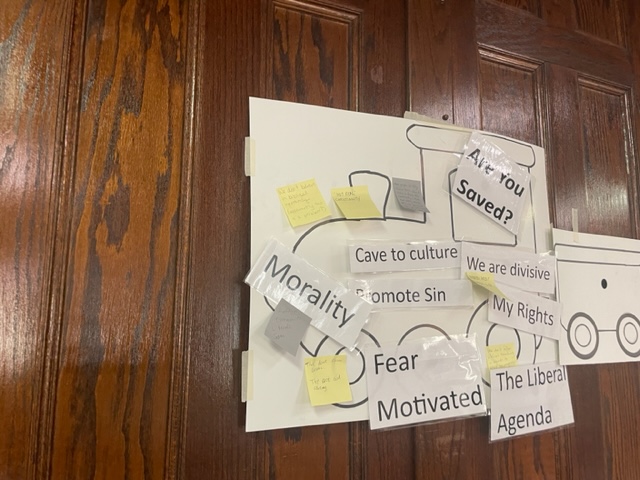
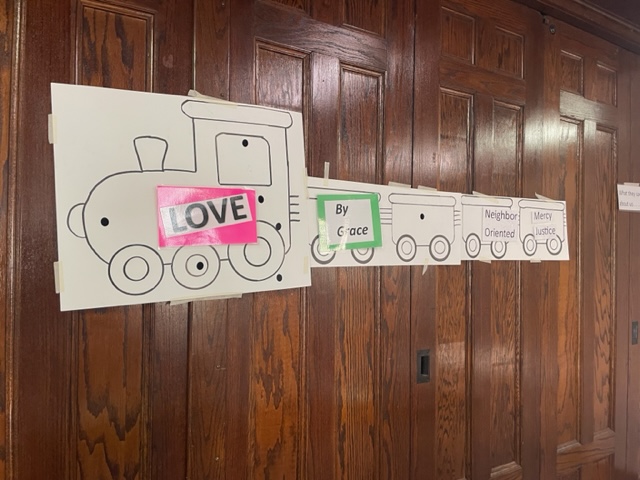
What powers the engine of our faith train? (We live in a railroad hub city – had to go there.) Detractors would say it is a liberal agenda. We would say it is LOVE. Love that God first showered upon the world, a love we respond to by loving God in return, and loving our neighbors as God calls us to love.

There are a lot of things that could drive the engine of their church – here are some of the thoughts that came to mind.

In actuality, this is what we aim for. The engine on our train is powered by the love of God. We know we are saved by grace. We are neighbor oriented. Mercy and Justice are key words in how we relate to neighbor.

Christian, But Not Fundamentalist

The ELCA (Evangelical Lutheran Church in America) a large Christian denomination in the United States.

Welcome to the Evangelical Lutheran Church in America (ELCA). The ELCA is a church of about 4 million members who actively participate in God’s work in the world. We believe that we are freed in Christ to serve and love our neighbor.

With our hands, we do God’s work of restoring and reconciling communities in Jesus Christ’s name throughout the world. We are a church that belongs to Christ. There is a place for you here. We live in many different communities, span all ages, cultures and races and bring to this church unique life experiences and perspectives. Seek answers to your questions and discover what God is calling you to in life.

ELCA.org

Who are we? One of the things about being a large denomination is that we don’t all agree on everything. In fact, the congregation I serve tends to lean toward the progressive side of most issues. Not all ELCA congregation are like this. Some are more conservative. Recently, I had a brunch with a group of members of my congregation so we could talk about how we talk to other Christians who have “defined us” in their own minds and in their own talking points.

Some of the things we talked about start with the reality that Christians seemed to have been able to disagree about things more agreeably in years past. All over the country, communities could have a Thanksgiving service with Baptists, Lutherans, Presbyterians, Methodists, and so forth, quite easily. We all believed in Jesus. It didn’t matter so much whether we chose to have grape juice or wine for communion. It didn’t matter so much whether we baptized infants, or only older believers. We believed in Jesus, worshiped God together, and set aside some of our differences.

Today, Christians seem to be more polarized. The difference is that some of these things are not just about opinions or doctrines. The places where I believe the lines are crossed are when individuals or whole groups of people are, 1. Dehumanized, 2. experiencing existential oppression, or 3. experiencing existential erasure. These things are all above and beyond the scope of difference of opinion, or even scholarly doctrine. They cross the line of experiencing “other” within the scope of humanity.

To Dehumanize another is to speak or act in such a way that people, whom we all consider to be made in the image of God, are less than human. Throughout history, dehumanizing metaphors have played a key role in the propaganda of genocidal regimes. Dehumanization always starts with language

Dehumanizing always starts with language, often followed by images. We see this throughout history. During the Holocaust, Nazis described Jews as Untermenschensubhuman. They called Jews rats and depicted them as disease-carrying rodents in everything from military pamphlets to children’s books. Hutus involved in the Rwanda genocide called Tutsis cockroaches. Indigenous people are often referred to as savages. Serbs called Bosnians aliens. Slave owners throughout history considered slaves subhuman animals.

https://brenebrown.com/articles/2018/05/17/dehumanizing-always-starts-with-language/

We can all imagine more references. What comes to mind when you see/hear the word “illegals?”

When a country is at war with another country, the enemy is usually referred to by euphemisms that dehumanizes them. When immigrants are fleeing from a dangerous place, seeking refuge, they are often referred to in derogatory, and less than human terms to keep them out of a potential host country. Are they less than human, of course not. But some people have a stake in keeping them out. “Antifa” is a relatively new term. At it’s root, it means to encompass those who are against fascism, as if it were a bad thing and we didn’t fight at least one World War over this. But it is a derogatory word meant to be spewed at or about the “other.” Using dehumanizing words is intended to makes the user sound or seem less cruel in “othering the other.”

Using words or phrases that do not mean what they generally mean, is also a language usage intended to draw allies and detract opposition. The “pro-life” movement seems to have Christian roots, but when they start dehumanizing the very human mother carrying zygote or fetus a line is being crossed. There is a strong correlation between those who expess “pro-life” opions, and those who favor the death penalty.

Existential Oppression overlaps dehumanization. This term literally means that some people find it acceptable to oppress the very existence of other people. Slavery is perhaps the example we can look to with the most clarity. In its day, and for many years after, it was common practice to take people from their home countries, communities, professions, and families, put them on slave ships, and create slaves out of human beings. It was a cultural norm to buy and sell human beings (because of their skin color) and treat them with cruelty, poverty, and hardship. In the United States today, human trafficing is still a major issue. Were they doctors, lawyers, educators? Did they have family, community, loved ones? That form of their existence was unimportant to those who stood to gain by their oppression.

Existential Erasure is from a similar mindset. Most often, it happens on a systemic level. (i.e. mob mentality). When American Indians were dehumanized by calling them savages (dehumanize), it became no more than sport to kill these human beings, and take all that they had. This and colonialism all over the world was supported and encouraged by Church Doctrine from the 15th century. (The Doctrine of Discover.) Hitler’s drive to erase the Jews from history is well documented. There are other forms of existential erasure that are less understood, but becoming far to culturally commonplace. Consider recent movements to ban books and ban black history from being taught. There are many excuses being used, but the end goal is the same – “do not let anyone know that this happened or that they existed.”

Do yourself a favor and visit a holocaust museum. At the very least, visit a holocaust museum website. Dehumanizing, Existential Oppression, and Existential Erasure all start with words. But they can have horrific consequences when the ball starts rolling and no one is there to stop it. Luke 18 gives us an idea how Jesus handled it when a self-righteous person “othered” another.

The Parable of the Pharisee and the Tax Collector

He also told this parable to some who trusted in themselves that they were righteous and regarded others with contempt: 10 “Two men went up to the temple to pray, one a Pharisee and the other a tax collector. 11 The Pharisee, standing by himself, was praying thus, ‘God, I thank you that I am not like other people: thieves, rogues, adulterers, or even like this tax collector. 12 I fast twice a week; I give a tenth of all my income.’ 13 But the tax collector, standing far off, would not even lift up his eyes to heaven but was beating his breast and saying, ‘God, be merciful to me, a sinner!’ 14 I tell you, this man went down to his home justified rather than the other, for all who exalt themselves will be humbled, but all who humble themselves will be exalted.”

Luke 18